
 |
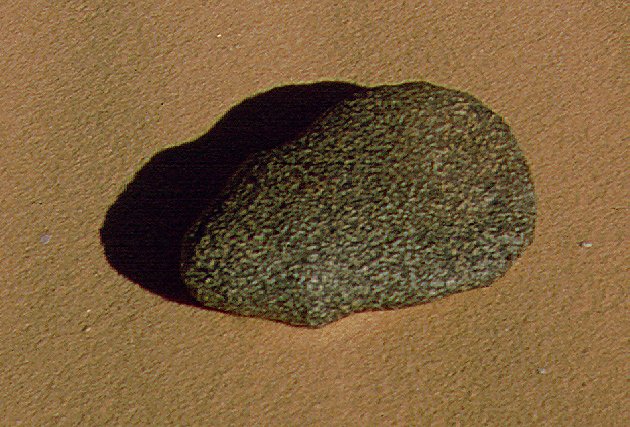
The Wadi Sora celt
UPDATE (1): New finds of Darfur axes in 2009 UPDATE (2): New Darfur axe find at Jebel Uweinat in 2019 |
Wadi Sora, the most important rock art site of the Gilf Kebir lies along the western scarp of the plateau. The 'caves' (wind excavated hollows at the base of a semi detached sandstone outlier) with rock paintings were discovered by Almasy during the 1933 Almasy-Frobenius expedition . While the archaeologist of the expedition, Hans Rhotert published the paintings in great detail, no published record was made of the archaeology of the area.
During our 1998 visit to Wadi Sora, a brief survey was made of the vicinity. The wadi itself is a short inlet along the western tip of the Gilf Kebir. The flat bottomed valley is nearly level with the plain at the base of the cliffs, and must have offered in prehistoric times just as now a sheltered inlet, that offers a clear view of the surrounding plain. The "caves" with rock paintings are located very close to the mouth of the inlet, which continues inwards for about one kilometre, with a conical inselberg occupying the inner middle of the valley. At the rear end, a high dune is blown against the face of the cliff, with a broad flat sandy area at it's base.
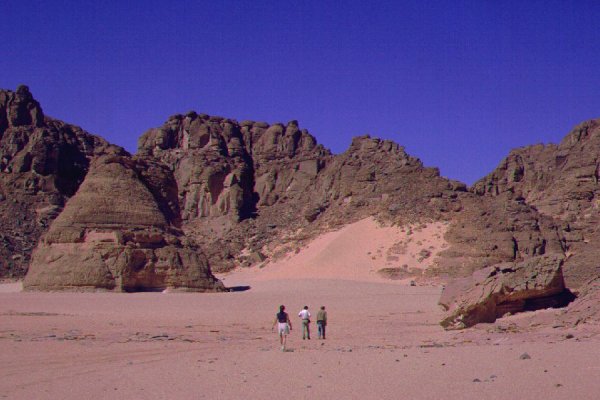
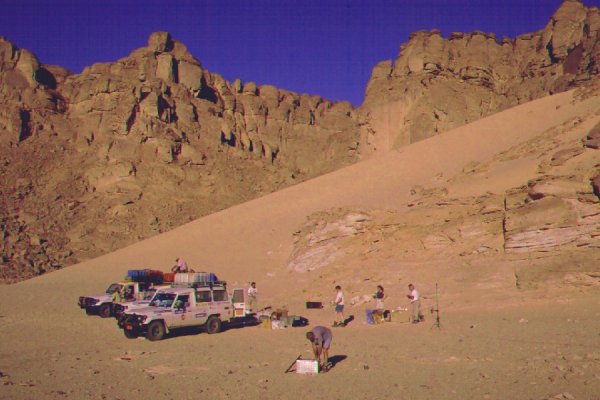
On this locality (which offers the best camping spot to this present day) we have noted a concentration of neolithic artifacts, composed mainly of well made microlithic and larger blades of quartzite, and the typical 'Gilf' type millstones of large grained sandstone. In the same area we found on the surface one implement that was strikingly different in both form and material from any other found, and unlike anything noted in the Egyptian part of the Lybian Desert
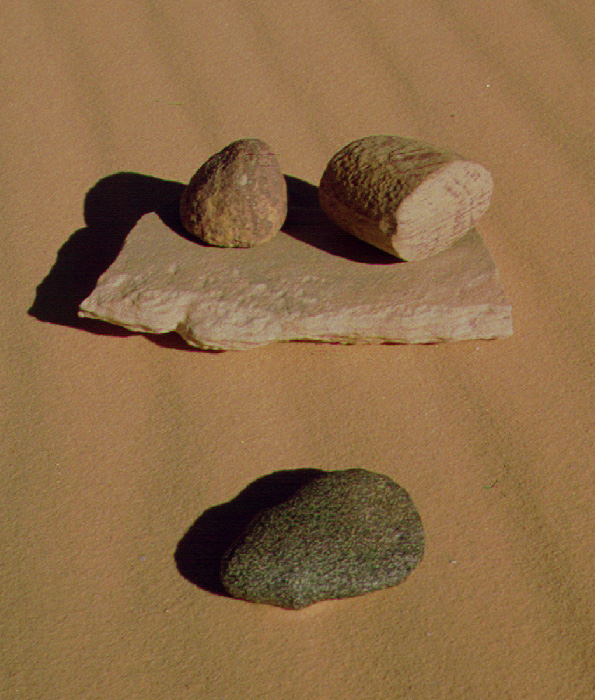
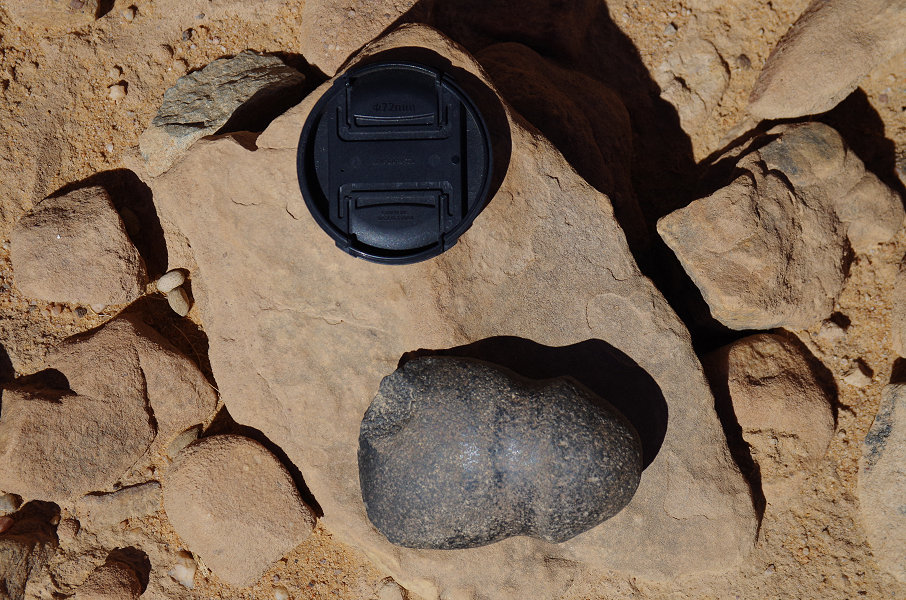
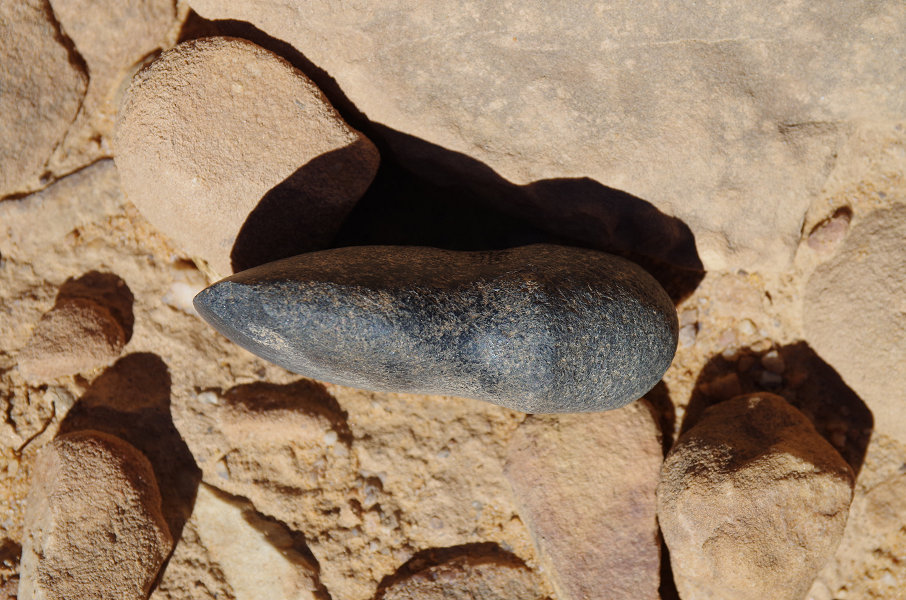
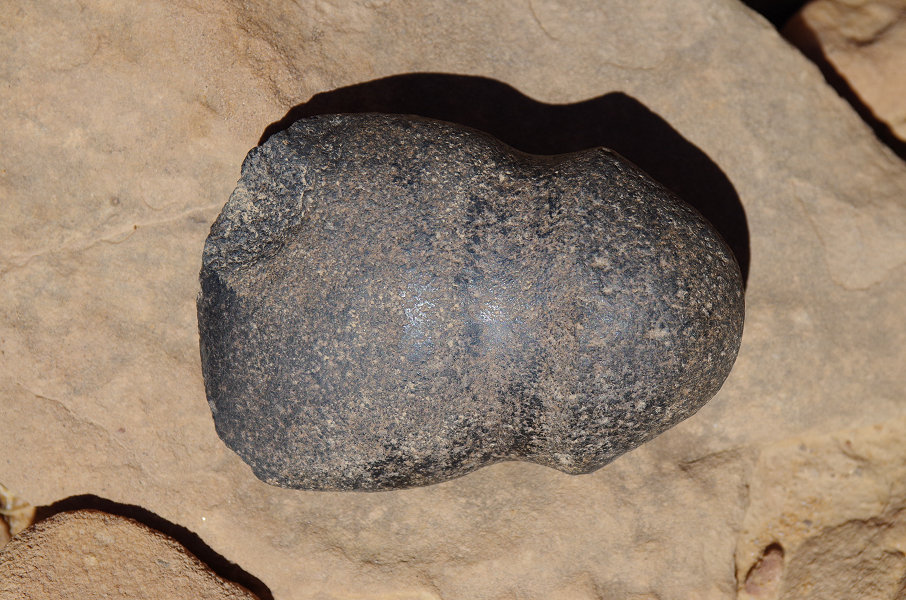
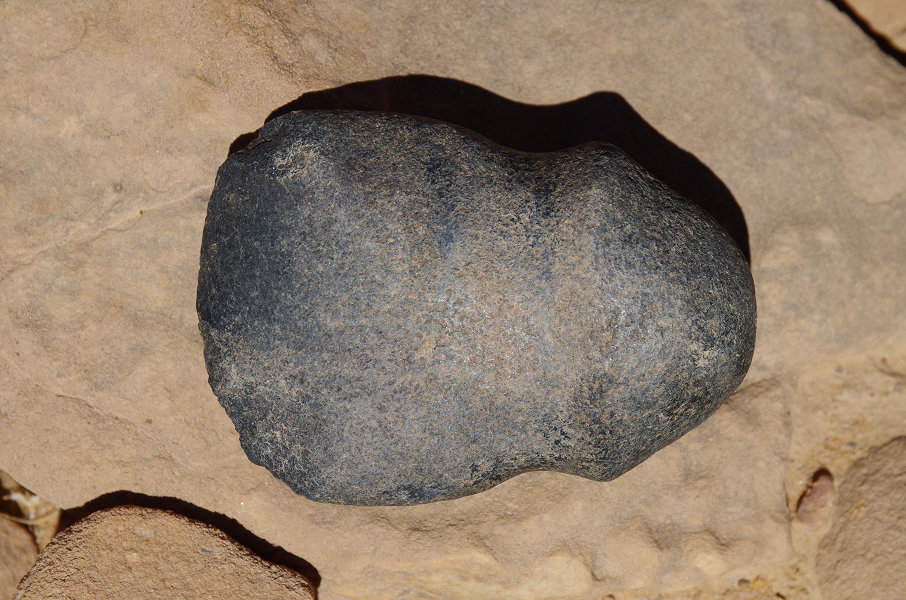
The implement is a ground, flat, pear shaped ax head with a distinct notch at it's tapering end, made of a fine grained green-grey igneous stone, tentatively identified as diorite or dolerite. (The closest possible source being the unnamed granite plateau 100 kms to the south, or the massifs of Jebel Uweinat or Jebel Arkenu, 50 kms beyond). The dimensions are: length 10.8 cm (longitudinal axis), maximum width 7.2 cm (near cutting edge), width at notch 5.7cm, maximum thickness 3.3 cm (ridge terminating notch) The lower (exposed) surface is pockmarked and polished by windblown sand, it's upper unabraded surface is smoothly ground but not polished. The sharpness of the cutting edge was obtained (and possibly maintained) by grinding the lower side flat at an angle to the cutting edge.
The only known similar implements are those found by Newbold in the Wadi Howar in 1923, at a straight line distance of 700kms to the south from Wadi Sora, and published in Sudan Notes & Records: "...we picked up from the floor of the depression five stone implements, like neolithic celts, ground and edged, but unpolished, and of very fine workmanship,..." Later and Newbold & Shaw discovered similar tools in the Wadi Howar, and one isolated example at Merga oasis in 1927, which were published in Antiquity: "... found more of the stone implements,... identified ... as being some of porphyrite, some micro-diorite, and some possibly dolerite... In type they are unlike any others I have seen or heard of ... ". More recently, Birgit Keding found a number of such implements in the Wadi Howar, and made the the most comprehensive treatment of this kind of axes ("Darfur axes") in her excavation monograph (Djabarona 84/13).
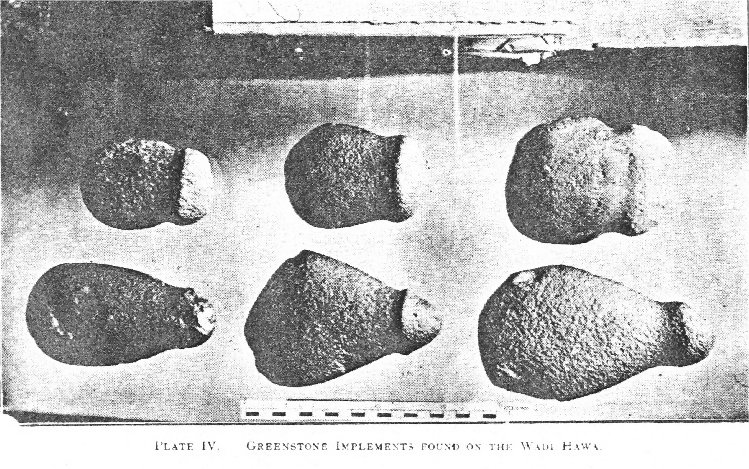
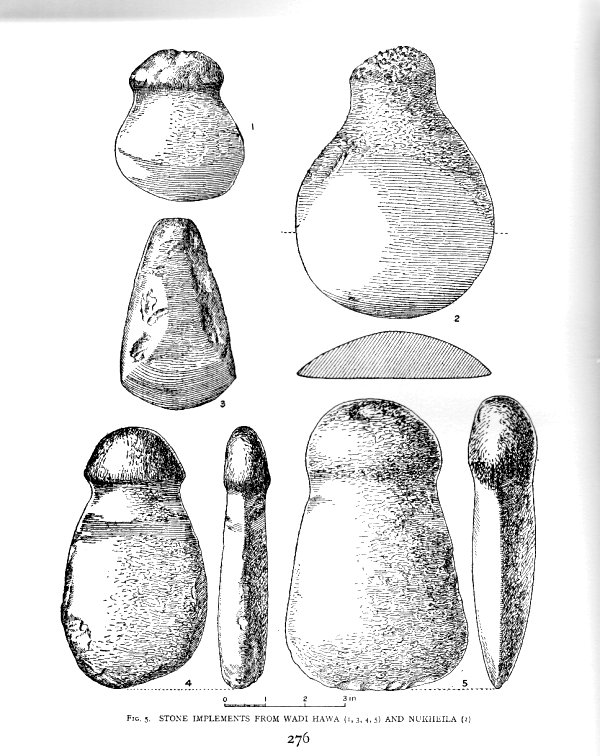
The discovery of this tool at Wadi Sora, hitherto known only from sites far to the south in Sudan, could point to a cultural link between the populations, already suspected from similarities in rock art, but unsupported by any archaeological evidence. For references, see:
Update (1) (January 2010)
For over ten years the Wadi Sora specimen remained the only known example of a "Darfur axe" in the Gilf Kebir - Jebel Uweinat region. There was a remote possibility that it may have been transported there in modern times. W.B.K. Shaw and company stopped there in 1935, after driving up from the Wadi Howar, where they have conducted some small-scale excavations and collected artifacts - perhaps one was accidentally lost here ? However all doubts were cleared in 2009, when two furher specimens were found, at far away locations, by Hardy Böckli and Mark Borda on separate trips.
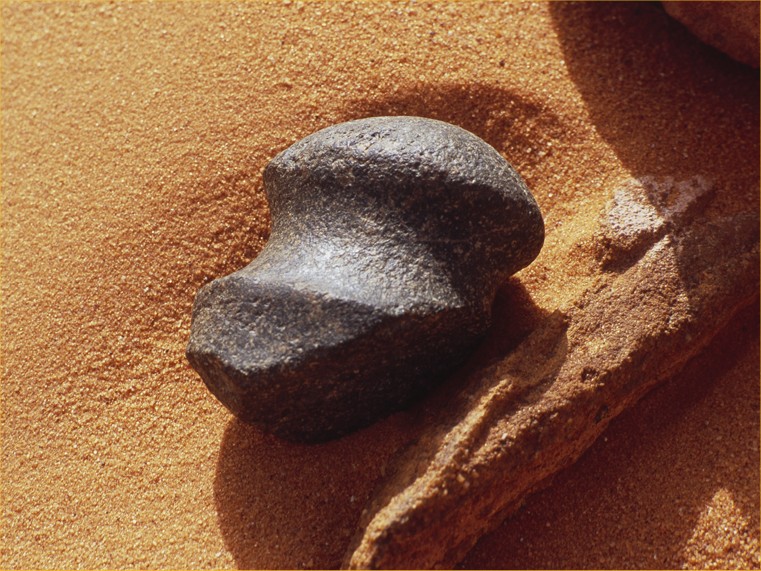
The first one was observed in February 2009, on the top of the Gilf Kebir plateau a few kilometres to the west of the playa basin of Wadi Ard el Akhdar. It was incomplete, only the broken off notched end remained, a search of the vicinity revealed none of the other parts. However even this incomplete example is readily recognisable.
The second find is even more significant, as it was found inside a shelter containing paintings of the cattle pastoral period along the eastern side of Jebel Arkenu, in October 2009. It is an intact specimen, identical to those depicted by Newbold & Keding in their respective publications.
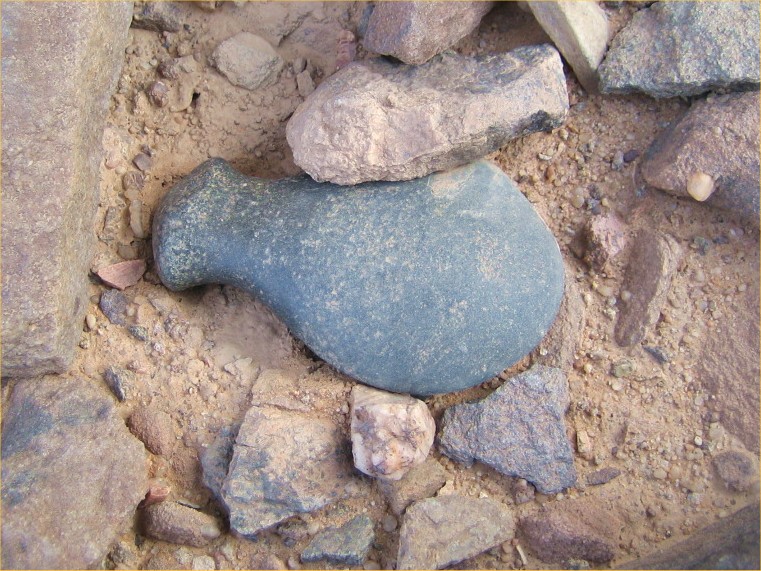
With these two new finds, it now may be stated with certainty that there was a cultural link in existence between the neolithic inhabitants of the Gilf Kebir/Jebel Uweinat area, and those of the Wadi Howar region some 700 kilometres further south.
Update (2) (March 2020)
After another ten years a further find of a "Darfur axe" was made at Jebel Uweinat on our March 2019 expedition. The polished axe made of basalt was found on the terrace at the side of the Northern Plateau where in 2007 Hardy Böckli found a shelter with some very fine pastoralist paintings (Böckli & Marai 2008, Sahara 19). Once again this type of polished axhead is associated with pastoralist paintings. There is a nearby (less than a kilometre) source of basalt making it likely that it was locally produced, unlike the Wadi Sora example, where the closest potential source (Jebel Babein) is a hundred kilometres away.

|

|

|